8 August 2011

Tricycles and wheelchairs Update3

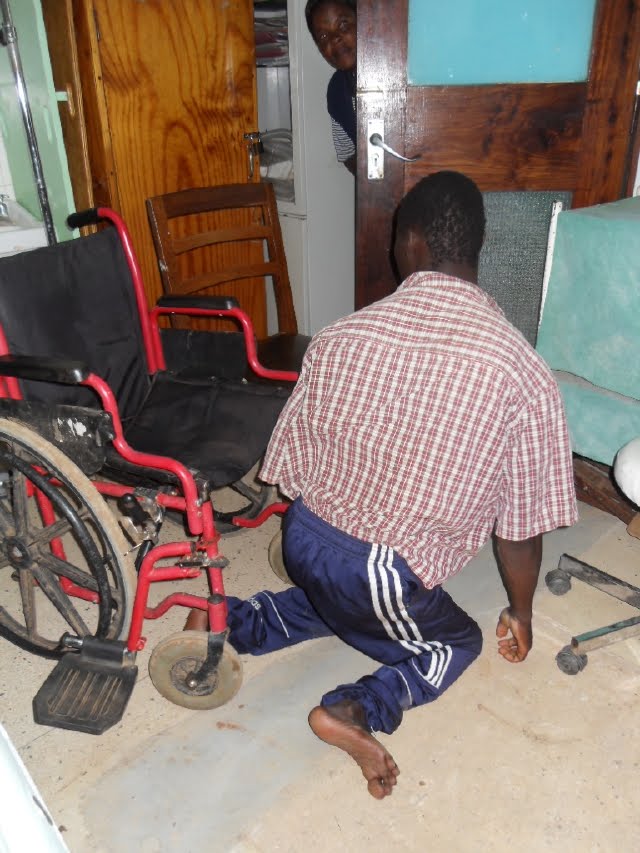
The suspense on MF is officially over. Her rather delayed delivery was a reflection of some realities particular to Malawi and indeed of the various mechanisms that exist to get around them. MF, now a 40yr old woman, lost the use of both her legs well in her childhood to that terrible disease called Poliomyelitis. She has learnt to get about since by shuffling on her hands and knees. She didn’t actually appear on the radar of MAP (Malawi Against Physical Disability) until 1.5 years ago quite incidentally after a routine admission to hospital. Now many of you will have wondered why Malawi Against Physical Disability uses the acronym MAP instead of MAPD! Well the reason is that MAP was actually an accurate initialisation of its original name Malawi Against Polio, but then had to be rebranded when the disease (thankfully) became quasi-extinct in the early 2000s.

To get back to our unexpected delay in delivery of the tricycle, this is what happened. The tricycle was actually ready more than 2 months ago. We then tried to get hold of the ‘client’, as they are known in MAP, whose waiting list the patient was selected from. Since most people don’t have a postal address in Malawi, they have to be located through their village or if they are in a big town, by a prominent reference point- e.g. “Ntcheu Boma, behind Petroda”. Sometimes, they use a well-to-do neighbour’s address. This is a service that often applies to mobile phones too, when the client does not have a handset of their own. Our first attempt at tracking MF was unsuccessful and we assumed that she must have moved away. So we sent a volunteer from her neighbourhood to investigate and after a while, he got back to us triumphantly having pinned her down. We probably had got her whereabouts misspelt and got misled as a result. This also isn’t uncommon here, where names are often spelt as they sound. With some sounds being so similar, two completely different locations can end up being spelt the same, or even worse spelt as the other! (Just consider these town names for a second and judge for yourself: Lilangwe and Lilongwe; Bua and Mua; Lunzu and Lundu). If that wasn’t enough, occasionally, the client themselves give us a wrong address, for a number of reasons (embarrassment, social issues at home, no fixed abode etc).

Another interesting little hurdle that further complicated matters was the fact that our volunteer was initially chased away. Our volunteer is part of an outreach network that allows MAP as an organisation to provide services to even the most far flung haunts in the land. Now strangers are not always welcome in villages, often because they may have had some bitter past experiences from fraudsters. Thus when our man first came to the village, he was perceived as a crook who would run away with the tricycle and sell it once it got made for MF. It was not until a few months later, when they heard about other people in nearby villages benefitting from our volunteers’ efforts, that they finally called him back and welcomed him.

I have to say that to have eventually managed in imparting to MF her designated mobility aid is a success story of sorts. Now this 40 year old formerly housebound maker of snacks can finally take her delights herself to the selling stalls at the market or elsewhere. Her specialties are the famed deep fried doughballs called Mandasi (to which I’m sadly addicted) and coated fish called Kanyenya. So if you ever find yourself buying one of these near Lunzu, make sure you look around to see if you find a tricycle parked nearby!
Look up MF’s first spin on her new bike on my latest videoblog: coming up soon


With Alex and Sally (from MAP) at MAP


Girl Power


Empowered!

31 July 2011

Blantyre Insolites... and surrounds

No comments!
Aucun commentaire!
Palibe Chonena!


Clinical Digest14

Gunshots

It has been another extraordinary period on the clinical front at Queen’s since the last update. On the one hand, there’ve been hair-raising moments like the recent unrest on the streets of Blantyre (remember 20July). On the other hand, there’s been a recent overnight escalation in my level of responsibility at the hospital. Both my orthopaedic consultants have been on leave simultaneously, leaving me to coordinate the entire orthopaedic department, with the assistance of a visiting surgeon from Holland, Jan Paul Frolke and Christopher (the chief OCO). Being the one making all executive decisions in the department I have to say is not something I’ve been called up to the task for before. Yet the challenge of it all generated enough motivation and energy required for this new role. I managed to reshuffle my duties to include more ward rounds, while making sure theatre lists kept running as normal. This felt like self defence from predators at times, with everyone around seeming to have their sights on this potentially vacant slot, desperately poised to make a go at it anytime. Thus more than once I had to fend off these predators and claim my territory!

How fateful that the majorest alert that I will have experienced in Malawi had to occur precisely during that period: The anti-government protests on the 20th of July!! I actually considered myself really lucky on that very day not to be on call, thinking I would plan the trauma list the next day to deal with the repercussions. It was a grave assumption to make that things would revert to normal by then. Instead of picking up the pieces from the day before (a total of 1 patient, who ended up under plastics instead of orthopaedics), I amassed a total of 3 severe gunshot injuries freshly from the aftershocks that were still happening in pockets of Blantyre the next day. It was a formidable experience to be on the frontline operating on these cases till early hours of the morning. Closest thing to MSF ever happened to me. LIVE gunshots! I remind one here of this strange phenomenon of the bizarre medical arousal which is a natural pill against losing it all in the heat of extreme moments in the medical/surgical profession.

The first case got sorted with the help of Dr Frolke who was still in the hospital at the time- an open elbow fracture with massive soft tissue destruction, including the ulnar nerve. We fixed it primarily with a tension band wiring technique and prayed for our plastic surgeon to work his magic on providing soft tissue cover subsequently.

The second case was a shattered wrist, with a through and through wound, in which the bullet somehow managed to skirt the median nerve and most tendons. The ulnar was not so lucky once again, but the damage done was surprising little considering the bullet that caused this injury. The wrist only needed a major debridement, after which it had enough soft tissue cover to hopefully deal by secondary intention. Of course, the possibility of any reconstruction of the joint itself could not be entertained for this patient within the resource setting of Malawi, but luckily most of the damage to the bone did not involve the joint.

The final case was what kept me on my toes till autopilot had to kick in. I kind of inherited this patient from the surgeons with a diagnosis of a comminuted open fracture of the proximal humerus. Since the wound was all dressed up in a bulky bandage to control the haemorrhage, I elected to do my examination in theatre. That is when I discovered the one tiny bit of information that was left out in the referral: that the entry wound of the bullet was actually through the chest while it was the exit wound that lay around shoulder! Partly owing to the delays encountered in getting operations done out of hours in Queen’s (some kind of a systematic deterrent to operate on anything but the most serious of all cases after 5pm),the patient had also managed to lose a significant amount of blood by the time he appeared on the operating table. Here I was expanding my initial plan for this patient to include a chest drain insertion, fluid and blood resuscitation in addition to the shoulder wound debridement. The latter was a typical example of the bag of bones description we reserve for the most severely comminuted fractures in the orthopaedic world. Unfortunately for the victim, his ‘bag’ was also in tatters and he would be another case on our esteemed plastic surgeon’s list for the next week.

That was a day in the life as Ortho reg in Queen’s. The remaining days found me mostly operating on forearm and ankle fractures, both fresh and non/mal-unions. The coincidence of finding so many similar pathologies in that short time provided the perfect opportunity for me to develop my surgical technique to the point where I feel quite confident to tackle these independently now (which I ended up doing twice). I owe a lot this to the very clever supervision from our visiting surgeon, Jan Paul Frolke and Christopher as well as to the encouragement from another visiting surgeon from across the road at Beit CURE orthopaedic hospital. It is incredible how much one can achieve from just having the right combination of factors in place at the right time. Some of these factors, which a priori might appear to be obstacles, indeed prove to be the catalysts in the learning process. Maybe that’s a lesson in Orthopaedics that resonates with my mountaineering vibes... There’s no such thing as bad weather; only inappropriate clothing!

18 July 2011

The uses of linea

First of all, a little definition of linea.

Linea: n.,inv. The ultimate example of recycled material. Made from the soft (side) part of used car tyres . The rubber is stripped into long threads, with incredible tensile strength and flexibility. These strips can be further split by separating them in the middle.

1. Rope. The higher the strength required the thicker the linea. Note: Linea can also be combined, by weaving or tying, to increase its strength.

2. Hanging flower baskets. Tied into a netting to contain a soil-filled coir bowl. Note: Linea makes an amazingly slip-resistant knot (a bit like Vicryl for surgeons out there!)

3. Reinforced packaging. Multiple linea strips can be combined to wrap around newspaper and whatever parcel, where bubblewrap is not available.

4. Fastener. This one really needs to be discussed by sub-section:

Transport
4a- To tie an endless list of things (from firewood to crates of beer) to the luggage rack of a bicycle taxi.
4b- To fasten together bamboo sticks into a portable chicken cage.
4c- To tie bundles together so they can be better balanced onto heads (sticks, leaves, reeds etc)

Round the garden
4d- To tie reeds and branches together into a fence.
4e- To tie tomato plants to stakes (as in our wonderful garden).
4f- To tie fine twigs into an outdoor broom.

In the market
4g- To attach items onto boards for display.
4h- To tie and reinforce bales, sacks and bags (of cotton, tobacco, potatoes, clothes etc).

Miscellaneous
4i- To lock doors and windows, when the key (or handle) has been misplaced!
4j- To fasten poles together (into scaffolds, roofs or animal pens).

5. Seats. Can be used to fashion both the back and the bottom support!

6. Football. When the air-filled variety can’t be afforded. The elasticity of linea lends itself well to this particular use (especially when combined with (smuggled) condoms, I’m told!)

7. Shock absorber. Perfect at the bottom of ‘fragile’ boxes. The thin strips should be used here, and laid down so they coil up on themselves.

8. Security barrier. Very useful in little shacks selling groceries in villages. It has the advantage, over metallic grilles, of being rust resistant and very cheap.

9. In the bikeshop. To mend bicycle punctures. In desperate situations, the leak is tied instead of patched. Also ideal to pad handle bars.

10. Art nouveau/ Recycl-art!

PS1: If you’re now wondering what happens to the tread bit of the tyre that doesn’t go into linea manufacture, rest assured, it doesn’t go to waste either. In actual fact, it makes great soles/flip flops.

PS2: Feel free to add to the list. The above sample is by no means exhaustive!!!


LINEA!


Held together by linea


You name it!!!


Linea-aided display


Nothing too heavy for linea

29 June 2011

1 car, 2 weeks, 5 holiday-makers, 6 flats

A timely visit by my mum and Janet’s mum and dad has brought a badly needed break from the relentless grind of work at Queen’s this month. As expected, work peaked to somewhat a climax before their arrival, just to make sure everything got sorted out. Then again, it was impossible to take the full 2 weeks’ stretch off at once. So we had a 4 day work intermission sandwiched in between. Thus the parents had a good chance to see Blantyre as well and get a better flavour of normal life here (as opposed to the resort-hopping tourist version). Since they’re parents, we thought they wouldn’t mind! But even in these 2 weeks less 4 days, the distance covered in miles and experiences has been enough to pack a holiday diary to the brim for them.

Malawi, despite being dwarfed by its neighbours, has more to offer than can be covered in just 2 years I believe. Rather than be lured back to the same established spots, we thus aim for a combination formula with new as well as old terrains. Rather than be lured also by the established mode of transport required for these epic holidays (a 4x4), we opted instead for a Toyota Gaia (took me a week to get the spelling right and find it on the internet) 7seater, which fitted our budget nicely and was better placed to meet our space requirements than the Rav4, which as the name suggests is only good for no more than 4 passengers. Rather than be lured finally by longer stays in fewer spots, we chose the converse (shorter stays in more spots) hoping to get more bang for our buck for our visitors (hope they agree upon reading this)!


New terrain1: Nkhotakota
After a night at a backpacker’s in Lilongwe (surprisingly quiet, rustic and convenient in fact) just to acclimatise our newcomers a bit, the adventure could now begin.
This wonderful sounding place, which was formerly one of the busiest seats of the slave trade in Malawi, is now a peaceful district fringed by one of the largest forest areas of Malawi and one of the most tranquil sections of the Lake Malawi. Having freshly picked our Gaia the day before after a cursory inspection which was unremarkable, we embarked happily on our first long distance stretch. Hardly half way through, purely incidentally, I noticed something amiss with the way the car was parked as we came back from a leg-stretch-stop by a road side market. Our first flat tyre had declared itself. Thankfully (3-fold), the tyre was not completely flat yet, there was a garage within 300 yards of us and right next to it was a tyre-fitter! Thus we got fixed within the hour and got going again. The 10Km approach to our resort in the Bua Forest Reserve was going to be our test for knowing if this car could cope with the planned itinerary. For most of it, the car actually did stand up. The last 3 Km however proved a little trickier than anticipated (we were guaranteed by the car owner and resort manager that even a saloon could get down this route- but I guess they had a 1 person saloon with no luggage in mind). Our Gaia was completely loaded and had less ground clearance than a mini. So the rocky sections required us to unload all passengers and get them walking. That wasn’t too painful. The car rattled for a bit from what we thought was a yanked bit of the exhaust but the problem self-resolved, so we never thought again of it.
Bua Forest lodge was idyllic to say the least. A perfect start amidst vast expanses of green, and amazing sunsets. A walk in the woods the next morning, spiced up by the sight of some mammoth crocs, got us ready for the next instalment- Nkhotakota Pottery Lodge (NPL). But first, our surprise finding had to be sorted out- flat tyre no.2. Luckily for us, the lodge manager was out on an errand that morning and managed to get it repaired before we were all packed and ready to go.
NPL was the perfect way to introduce our visitors to the lake (which they excruciatingly resisted dipping into). While Janet and I camped, they enjoyed amazing lakeside chalets with the best wake-up views you can possibly find around here.

New Terrain 2: Mua
Well fed and refreshed from that spot the next morning, we attacked our second long distance drive to a hillside village by the name of Mua. Mua needs no introduction to most of Malawi’s Christian community as it was one of the first sites of activity of the ancient “white fathers”. It has been the hub of the Catholic denomination ever since and has been kept pristine with incredibly beautiful gardens, an amazing church, a peaceful and colourful way of life (full of a capella singing and meditation) and a fascinating array of art. We toured the cultural museum there with its dozens of frescoes and were simply charmed.

New Terrain 3: Monkey Bay
Another overnight stop in a fantastic location, and we were energised for the next leg. Having ditched the testing roads to our established resort of Cape Maclear, we diverted towards Monkey Bay instead. What a fascinating discovery this was for us, let alone for the fascinating sceneries leading to it, teeming with birdlife as I’ve never experienced before outside a park (long-tailed glossy starling, brown-headed parrot, long-crested eagle, glossy ibis, ?African hawk-eagle, grey lourie, little bee eater, brown-hooded kingfisher etc). Monkey Bay had far fewer places on offer than Cape Mac, but to have found a better spot for us would have been difficult. Trading comfort somewhat for style, we got basic rooms in a relatively deserted backpackers right on the lake, safely shielded from the hectic drone of the town less than a kilometre away. Our arrival coincided perfectly with a boat trip that was happening that day and we got ourselves one pretty unique experience of the lake! The bird life, once in location kept accruing and I was totally in my element.
As we got back from our boat trip, we came across nasty little discovery 3- another flat tyre. Luckily we got it fixed in town not far away, while taking in the daily local life to the tune of a green (Carlsberg lager)!

Old terrain 1: Liwonde National Park
Somewhat reluctantly saying goodbye to this newly-discovered paradise on earth, we set sail for Liwonde. No other place probably holds a greater pull on me in Malawi these days than this place, largely owing to its amazing birdlife. But this time around, the tourists were treated to another little gem... or a rather big one: ELEPHANTS! It’s not every day you get to see elephants in Malawi’s parks, especially if you’re on a boat and not land safari and you’re told that none has been sighted for at least a week there. But having that box ticked so quickly on my tourists’ list, I could now relax!

Old terrain 2: Blantyre
Being deterred from staying at Liwonde by the prohibitively expensive lodge there, we headed straight to Blantyre that same day. That was another epic drive taking us right through to late evening. Crash start back at work for another hectic week of operating, on-calling, lecturing and examining. Meanwhile, the parents had a little self-styled insight into the normal working life we lead here. That didn’t stop Phillip (Janet’s dad) from going on a deathly ride to Limbe on the bike, that even we haven’t dared to do yet!

Old terrain 3: Mulanje
Again this one has been done to death on my blog, but suffice to say that it cannot be omitted from a tourist itinerary in Malawi. If you happen to have been taken around Malawi before and not seen this rooftop wonderment, then please ask for your money back. Mulanje also formed the seat of our 4th flat tyre, a front wheel this time. We realised by now flats must be very common in Malawi (especially ones with nails!) as there are tyre fitters pretty much everywhere.

New terrain 4: Blantyre (different angle)
The week in Blantyre was also accompanied by a certain training routine as, coming back from Mulanje (where I did not attempt any significant hiking for once), I would join the 3 peaks of Blantyre odyssey that Saturday. 45 Km. 3 peaks: Michiru, Ndirande and Soche and dozens of little villages in between. 25 odd people started, with about 15 finishing. Phillip joined me at first in a highly laudable attempt at crossing the finish line, but the soaring heat of that day proved too much for him, having had less than 2 weeks to acclimatise. He did remarkably well to complete more than half the route, at a ridiculous pace set by the group, which was faster than I’d ever gone before. I myself barely managed to finish, even after having swerved off the main peak to get Phillip back safely. The spectacle of the entire trek was phenomenal though and presented an entirely new Blantyre to us.

Old terrain 4: Zomba plateau/ Ntcheu/ Lilongwe
This was a redo of our epic bike ride from a few weeks back, but with the added luxury of cushioned seats and motorised wheels this time. What a difference that made! We stayed at the top next to a trout farm in a magnificent wooden cabin fit for the gods! I have to stop saying “amazing” now lest you stop believing me, but this place was one fairy tale of a one.

Our drive down the next day added the final 2 tyre punctures or punctuations by now to our journey. The first one was while driving down from the plateau along a narrow high held winding road. Thankfully, we kept control of the car. There was no magic tyre fixing possible this time, the tyre in question having through its 3rd failure, which was a burst this time! So we got the spare tyre out and decided to run it to the end. We dashed through Ntcheu for a little trip down memory lane. Then we had to alter our plans of breaking our journey at Dedza, in case we got another flat the next day which would leave our guests stranded away from the airport. What a prescient decision that was, as hardly after leaving Dedza pottery for a final shop, did I start to feel the car wobbling about on the M1. I thought “this time it’s the whole wheel balancing or something major gone wrong”. But hey lo! what did we find? Our 6th and final puncture! The big difference this time was the setting. It was very dark as we had to extend our original route. There was no civilisation in sight. The road was a busy highway travelled by trucks and speeding motorists AND we had already used our spare tyre. Our tyre had to be fixed somehow or we’d have to resort to something else. That’s precisely what we had to do when after 1.5 hours of waiting for some street youths to take our tyre away for fixing. When they came back with it still flat and with a useless valve on top of that, which they had tried to sort out with melting plastic! All this time, we have a consortium of village kids who’d gathered by the roadside to stare at this rare and amazing scene- stranded muzungus! Thus they kept chirruping away in Chichinglish for the entire length of time, giggling and heckling at us, having nothing better to do. By then, I thought “desperate gotten ails by desperate appliance are healed!” and called for help. This didn’t come until 1.5 hours later, by which time we’d managed to push the car just enough to be out of earshot our little persecutors and the indistinct hard shoulder of the road. Meanwhile our self-appointed tyre fitters hadn’t gone to rest over our case and had brought a 10+ tonner from nobody knows where to tow us away. At about the same time thankfully, our two rescue vehicles also appeared almost simultaneously (the VSO emergency vehicle and our car renter’s [John] own support crew). What followed was pure delight. In our trance-like state of exhaustion, we looked on, like at a scene from the A-team! John, like Hannibal, got his man working on the tyres and the battery (made flat by our hazard lights) like clockwork. The VSO tow bar turned out not to be compatible with our vehicle and the 10+ tonner got promptly dismissed. The car was up and running within 20 minutes, with 2 spare tyres this time and we drove on to Lilongwe escorted by our 2 rescue vehicles. The human lesson from this was suitably heart-warming after such an adventure. All throughout the agonising wait along the cold and exposed ‘motorway’, the Malawian entourage that had gathered around us were ensuring our safety and seeing to it we got to our destination somehow. Whatever little token of appreciation they expected in return does nothing to diminish the brilliant warmth of their nature. This was one destination we couldn’t have taken our visitors to in any direct way but they saw it for themselves: THE WARM HEART OF AFRICA!


Tricycles and Wheelchairs Update 2

Unreassuringly quiet as it has been on this front since my last update, the tricycle project wheels are now confidently back in motion. The logistics of course are what has proved the greatest spanner in the wheels with this... as for most things in Malawi. And when you haven’t got wheels (the motorised type!) and have to do all the chasing over the phone yourself, in the midst of an insanely hectic timetable(of an orthopaedic reg at Queen’s), well the brakes can easily get stuck! Thankfully, with the right amount of motivation and moral support, lubrication can be applied to loosen this grounding friction. With another 2 tricycles now doing good service on the streets of Ntcheu and now also Blantyre, I’m glad to announce we’re up and running again!

Since the success of the first 2 tricycles in Ntcheu, the word has gone out on the streets and attracted a number of new candidates of their own accord to the project. This revealed a fact to me-that demand for mobility aids has been there for a long time but people have just learnt to live (somewhat painfully) with their disabilities due to lack of money and government assistance to acquire one. Once the opportunity appeared to get a tricycle, we didn’t have to wait for new casualties to arrive but had enough long term disabled ones to pick from. Thanks to the assistance from my Ntcheu-based link, Mr Mittawa, the initial technical assessment and measurements are done before I get there. This greatly facilitates the order chain so that all I have to do is meet the new candidate and assess their suitability for our mobility aid. Mr Mittawa works as rehabilitation technician at the district hospital and is, I hope, going to keep things running once I’ve left.
The first new recipient of a tricycle is Chisomo Madyaudzu, a charming 23 yr old boy who is perfectly able-bodied save his legs. He was born with a very mild form of cerebral palsy, with minimal impact on his mental faculties. Thus he has not let disability get in the way of his life too much and went through vocational training to become a tailor. Owing to his physical impairment, he has always been based at home, with limited business opportunities. What a tricycle can achieve for him is probably the best it can achieve for anyone, that is empower them to move from a home-based hidden existence to a main street business where they can thrive. One can say that Chisomo is the lucky one, since he came to our attention first, ahead of all the new ones now who are on our waiting list. This is because his mother is a staff at our hospital and, no sooner had she caught sight of the previous shipment of our first 2 tricycles than she set out on a mission to find out how her son one could obtain one too. Just reward for being proactive I say. Chisomo has unfortunately had to wait more than 2 months to lay his hands on the tricycle though, owing to lack of transport to get the bike transferred to Ntcheu. We do have a Ntcheu vehicle that comes to Blantyre now and again but coordinating these visits with the collection of our tricycle is the same on the scale of difficulty as getting a bus from the depot on time and reach your destination without one delay or another!

Which is why I thought it was time now to widen the net a bit and turn to my own backyard for new clients. So our second beneficiary is a Blantyrite and it’s a SHE this time. I have tried as much as possible to be impartial with the allocation of tricycles but since Blantyre already had a long waiting for them and many of them are ladies, I thought I’d pick the first lady on the list. I don’t think that can be termed unfair given the relatively poorer chances of access to health care services that this gender enjoys in Malawi. Considering how statistically speaking empowering a woman can be so much more (cost) effective than empowering a man (given the male scourge of alcoholism and irresponsibility with money), that again quelled my discomfort pertaining to this bias. In fact it made me even wonder whether I should limit my field of activity exclusively to women and let the slow trickle in the system take care of the men! But I don’t think that’s fair either. So JD will my first Blantyre beneficiary and I shall revert to the natural order of the list, combining Blantyre and Ntcheu. More to come on that one in the next update...


Chisomo before


transferring


Being measured up by Mr Mittawa


Tricycle delivered through Mr Phiri- District Nursing Officer


Family meeting Chisomo (family form a major part of my sponsoring network)


Happy. Smiling. Empowered.

Clinical Digest 13

To nail or not to nail...

My area of interest within developing world orthopaedics has slowly but solidly, while in Malawi, become the femoral shaft fracture. Quite understandable given the implications this condition holds here. From my audit of inpatient orthopaedic diagnoses in Ntcheu, I established that this was the commonest one on the adult male and female wards, even commoner than the neck of femur fracture. The same held true on the paediatric ward, ahead of infectious affectations of the bones, joints and soft tissues combined. Given that, of the adults, it tends to affect the younger age group, who are working and economically active, the socio-economic impact is also quite significant. This is compounded by the resultant consequence of impairing the very ability to work of this age group if a less than optimal outcome is achieved following treatment. The history of the management of femoral shaft fractures is quite fascinating indeed, as it reveals many insights into the divergent nature of scientific research (between first and third world). As for the biomechanics and principles of treatment, they are equally fascinating in their own rights. I can certainly comment on the operative and non-operative management of this condition for Malawi. The way this relates to global trends is very interesting.

The management of femoral shaft fractures in developed economies is usually guided by the very latest technology, without being hampered much by cost considerations. The degree of excellence in terms of accuracy of reduction, time to return to normal function and infection rates, to name a few outcomes, could be argued to have come very close to the best it will ever be. The level of research conducted into femoral fractures, and for that matter most medical problems, in most journals tends thus to focus on subtle improvements in one or more outcomes. These improvements, unfortunately, hold little if any relevance to environments where even management approaches from 50 years back or more still pose logistic, financial and other challenges. Apart from helping the district level clinician from understanding the physiology of fracture healing or the properties of metalware they will never get to use, this research is of minimal benefit to them. There is a real paucity of contemporary research into the management of conditions in resource-limited environments. Low resource approaches used in the past often hold serious implementation challenges, given the non-availability of many components they used to employ. These, since the methods have been abandoned, are often no longer widely produced. This in turn, has had the direct effect of boosting up their prices, making them no longer economically favourable. When treating people in a district hospital, which is the typical health care setting for most Malawians, one has to recognise these problems

The gold standard for treating femoral shaft fractures in modern western health settings is through the acute insertion of a locking intra-medullary nail. This can be offered to some but not all people in our central hospitals in Malawi. The majority of our femoral nails however are unlocked (K-nails), thereby offering poor control of rotation, and then also, they represent less than 30% of our patients. Our K-nails, although available, are far from ideal and the only way to keep operating at times is wicked improvisation. To illustrate this, consider a recent case we did where we needed a 38x10 size nail. We had no nails of such a size and to get the diameter had to combine two 8nails. Now if we had two 38zx8 nails, then that would have been job done. But things aren’t that straight forward here as we had only size 42x8 nails and ended sawing 4cm off the combined metallic nails for about half an hour! The rest (majority) are treated like in the district. A large number of our nailings are done for non-unions, after conservative treatment has failed. This (conservative) is the standard treatment for the district and that usually means skeletal traction, typically via a tibial pin.

When I was in the district I observed the management of this fracture closely. Rather than deplore the lack of intramedullary nails and specialists who can insert them, I believe they should focus their energy on finding ways of improving the outcome with the tools they had. The lack of academic presence in the district and the rather poor rewards for the thankless task achieved by the orthopaedic clinicians there mean than little if any effort is spent on finding improvements. I certainly can think of many low-cost, widely available measures that can be employed to improve outcomes like rotational deformity, speed of recovery, length of stay, knee stiffness and pin site infection. All that is required is the dedication of the clinician and their will to spare some time at the beginning to implement these measures. As the nails hopefully become more streamline in the central hospitals, maybe we can start then to work on their implementation in the districts. By that time, also one would hope there’d be enough doctors or senior OCOs in Malawi to undertake this task there.

17 May 2011

Are we there yet (Part II)?

Here is an early untested theory on memory! In the early days following an event, the brain has a tendency to focus on the hardships endured more than the joys derived in the process. Yet as time passes by, these painful memories slowly start subsiding to leave place for an overall positive recall of the activity. This, need should there be to clarify, holds tru-est for long hard slogs more than your ordinary walks-in-the-park-type activities. And should you want to consult my wife, my sense of planning has lately been rather skewed in the direction of the former. Having survived Mulanje barely (and the limping week to, at and back from work that ensued), the plan was to take the new bike out for a test. Janet’s new bike that is. The best bike I think we’ve ever laid our hands (and feet) on. So nothing should really been too much of a push for it. Of course, my handicap for the trip would be to ride a standard Malawian bike with all the friction that can possibly be generated from its moving parts. Having happily used it around Blantyre I thought that the overall added difficulty wouldn’t be too much for me to take. So I thought of a nice return trip to a place not so near but not so far either: Zomba. How I came to that distance assessment is something neither me nor Janet ever questioned. We simply assumed that it looked closer than Mulanje on the map and Mulanje is 50 something from Blantyre. Since the unit of distance here is the Kilometer, our estimate was that Zomba was less than 50Km from Blantyre. That’s a doddle really in our books. Having been known to do 20 a day to work and back in the UK, 50 over a whole day can’t be that bad. Here’s how this trip differed from this arbitrarily selected UK reference point. The weather in the UK might be sh*** but it is cool and doesn’t sap you of your will to live like a midday Malawian sun. Secondly, the average terrain is somewhat more level in a British city like Manchester than the endless undulations encountered between Blantyre and Zomba. Lastly, and most significantly, the unit of measurement I used inadvertently was 50 Km when, in reality, it turned out to be 50miles! So the whole trip was more like 75 odd Km each way. Try and explain that to the loyal wife who slogged some 20 hours’ of mountain walking for you one weekend ago!

Back to my theory on memory. So, there is its classic application: Hills, in particular undulations along a route which is flat on average! Yes, as you proceed one way from point A to B, you remember the hills (read hardship) mostly and think that the overall gradient was an uphill one to your destination. Hence the return trip should be much easier, being by default downhill! But here’s the catch. On the way to point B, you forgot to factor in the bits of the trip that felt easy (the bits after the hills that is, when you’d relax your legs a little). These easy bits of course became hills on the way back. Since the hills take longer to get through than the flats and descents, the overall impression from point B to A again becomes one of uphill. Thus I conclude that man has a preferential memory for pain in the short term than for pain-free goings on. And this pain gradually gets converted into a sense of achievement which is perceived as a positive memory long term!

Back to Zomba. It will certainly live up to be one of our most enduring memories of Malawi. Formerly the colonial capital of Malawi, it boasts some amazing architecture including the lodge where we stayed. Fringed by a superb plateau, its scenic potential is also very close to Mulanje’s and Nyika’s. While Mulanje is the wildest and Nyika the smoothest, Zomba wins the lot as the greenest. For those who dare not take the potato path as we did up the 700-800m up, there’s even a road that takes you there. (Small insight into the origin of that name- it was and is still used as the crossing route by farmers between the potato growing plains in the Domasi valley east of Zomba to Zomba market where they can be sold.) And don’t worry if you don’t have a car. The business of organising taxi ferries up the plateau is thriving in town. If you happen to need a taxi on the way down alone, then the economics are largely swayed in your favour as there are enough taxis that have only been hired one way and up. So they’re empty on the way down and will only take a couple of hundred Kwachas. Considering, they’re on neutral gear most of the way, they couldn’t realistically hike the price up any higher to cover their fuel cost! Beyond the adventure, the scenes and the streetwis-dom, Zomba was our bank holiday escape Janet and I to mark (somewhat belatedly) our 6th year of being together. That’s got to make a place memorable.

Zomba Plateau

Lush Greenery

Beauty & the Beast (or other way round!)

Are we there yet (Part I)?

There are few places in Malawi laden with more meaning for me that this one colossus. Dominator of the skies from Kilimanjaro to the Cape, it is a place where the soul roams free, away from all the overwhelming chaos and din of lower lying areas. The only noise here is that of Nature. It is my one favourite recluse and yet I haven’t paid it real justice yet. Mulanje- Malawi’s island in the sky. Malawi’s jewel of biodiversity and also its most mysterious corner, imbued with more legends and myths than any other single place. The immensity of it naturally lends itself to such fancies but let’s face it, any mountain of such a scale will have its casualties. There exist enough plausible causes to not have to attribute any to spirits and the like. Perhaps one benefit of that is that the mountain is avoided by many, thereby keeping it more pristine. Unfortunately, of those who do actually tread there are a number of unwanted individuals- namely loggers and poachers. I would refrain from calling them vandals, considering the factors that do lead them to such desperate means of survival. It certainly is no mean feat to try and come up this mountain to scrape a living. One often risks their own lives, be it from forest scouts or the leopards they hunt, let alone the harsh conditions that prevail up there. Mulanje boasts the honour of supporting the largest number of Malawi’s national tree – the beautifully scented Mulanje cedar. This is a tree that’s incredibly difficult to grow by man’s hands. Sadly, every passing year sees its numbers dwindling scarily given its propensity for making curios and other artefacts for one time visitors who largely haven’t got a clue. Even more alarming is when the wood is not even chopped but lit by arsonists to scare animals as part of their traditional hunting method. This leaves vast areas of the plateau reduced to cedar graveyards.

But despite these sad details about the vulnerability of Mulanje, it remains one of the most ecologically fascinating areas of Malawi. Whether you approach it with your gaze facing down with a microscope or facing up with a telescope, there are gems to be found everyone. I already listed my repertoire of birds on this plateau. Land animals do also reside here, except that they have (rightly) become very elusive from man. Our last venture out there brought us close to klipspringers. There are also loads of rock hyraxes and fewer leopards that prey on them. The most diverse aspect of the flanks and plateau however has got to be its vegetation. There are no two times of the year when you can expect to find exactly the same things emerging from the ground. The famous pan-seasonal delights are undoubtedly the sunflowers. They exist in so many varieties (in size, colour, shape, density, you name it) and are so abundant one can almost feel a sense of security about their survival. Among the more seasonal features are the protea flower, red hot pokers, vibrant purple Mulanje irises, glorious aloes and dizzying vellozias, which can hang from any rock no matter what the gradient, and their amazing lilies.

Of course, I’m reminding you of Mulanje here because I’ve only just reminded myself of it not so long ago. My friend Tor (Norwegian surgeon from Lilongwe) wanted to organise a farewell trip prior to leaving Malawi. We formed a team of 8 (5 Norwegians, a Belgian girl and Janet & I) and decided to approach it from a different starting point to the one I’ve always used before. Our chosen path was the Lujeri one, which starts from a beautiful lush green tea estate that seems to have no limit and is flanked by natural forests as you begin your ascent. At first, I planned to stagger the whole thing over 3 days giving us enough time to ramble and recuperate. At the last minute though, this had to be shortened to 2 days, as both Janet and I had to be back at work. So we made slight adjustments to our plan, so that we (and our Belgian friend) could come down earlier than the rest of the group. Instead of saying: “let’s scrap the peak” though, as in retrospect one would hope we had done, we thought: “let’s start earlier on the peak than we planned”. Of course, that adjustment did nothing to reduce the overall distance covered and only added the pressure of time to our schedule. Having clocked an amazing 8 hours’ walk the day before, with a 6am start, we started our second day with a 5am start! 5 hours later, after having elatedly conquered the height of Malawi at 3001m (Sapitwa Peak), we began to contemplate the route ahead. My team (Janet and the Belgian girl) were already somewhat drained by that stage and I could already anticipate a return journey to the tune of “are we there yet’s”! As it is in Malawi, number guessing is as accurate a science as cloud figure guessing! Thus we were told anything between 3 hours and 7 hours. Erring on the side of caution, we allowed for the higher limit and estimated that we would make it to the bottom and across to the bus depot in time for the last bus to Blantyre. And how precise that turned out to be! Once at the bottom, we managed, within minutes, to get a ‘matola’, but in the local style. That is, while thinking even we couldn’t fit in the back of that pick up with all our bags, we managed to gather 5 more passengers along the way. If you dared to breathe too deeply you might just tip over the side! Back at the depot, we hardly had time to get a soft drink before the last Blantyre bus came along and was ready to go... In fact it was a Limbe bus (the small commercial town 3-4 Km from Blantyre). But then, we learnt a little trick of the trade here. If you negotiate an arrangement with the driver from the start, you can top up your fare by a couple of hundred Kwachas and get him to drop you off further. Of course that only works with the last bus of the day. And for us that was ideal. We snoozed all along and in the end got the driver to take a route that delivered us on to our very doorstep. After a day of trying to make it up to Janet for the somewhat extreme planning, I could finally answer “we’re there now”!
Lujeri Valley

Our team

Before Sapitwa (seen in the back from the plateau)

On Sapitwa

Mulanje Iris